
BATTERY KNOWLEDGE
Why Solar CCTV Batteries Run Low Even When Charging
A solar CCTV battery can receive charging current every day and still run low. Learn how to check daily power consumption, solar energy balance, controller settings and battery recovery before increasing capacity.
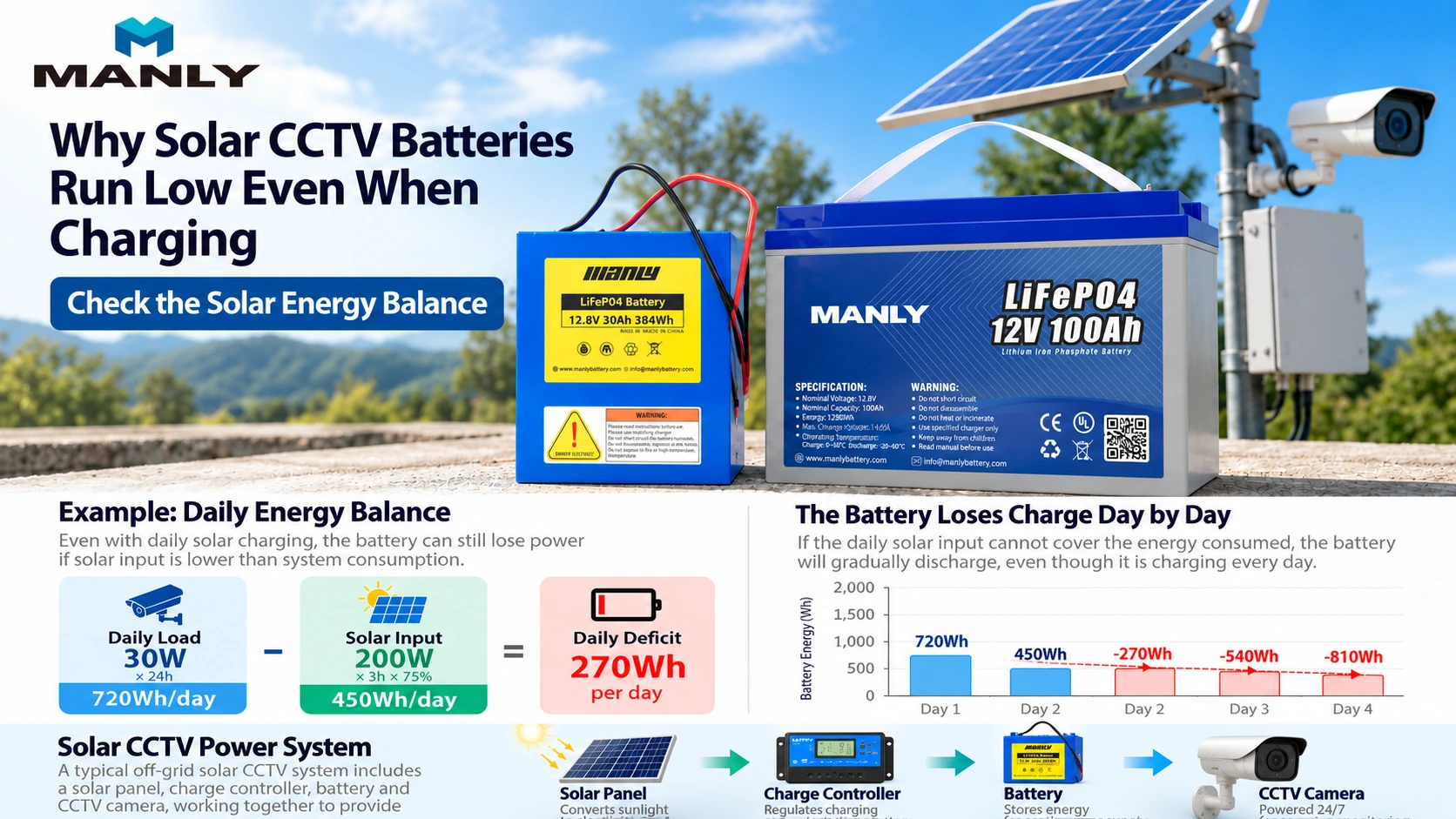
Published 2026-10-08A solar CCTV system can receive charging current every day and still shut down after several cloudy days. The battery may have enough capacity to power the cameras overnight, but the solar array may not generate enough energy to replace what the equipment consumes.
For solar CCTV manufacturers, mobile surveillance tower builders and off-grid system integrators, this is an important distinction. A larger battery can provide additional backup time, but it cannot correct a persistent shortage of solar generation.
Before increasing LiFePO4 battery capacity, the equipment load, solar output, charging conditions, usable battery energy and recovery time should be evaluated together.
1. Why Does a Solar CCTV Battery Keep Losing Charge?
A charge controller displaying a charging symbol does not necessarily mean that enough energy is being delivered to recover the battery's daily consumption.
Three different conditions may occur:
- Positive energy balance: Usable solar generation exceeds equipment consumption over the assessment period, allowing the battery to recover when charging conditions permit.
- Approximately balanced operation: Solar input is close to consumption. Weather changes, additional loads or conversion losses can gradually reduce the state of charge.
- Negative energy balance: Equipment consumption consistently exceeds usable solar generation, causing stored battery energy to decline.
The engineering question is therefore not simply whether the battery is charging. It is whether the system can replace the energy consumed within the required operating and recovery periods.
2. Calculate the Power Consumption of the Complete CCTV System
Battery sizing should begin with the total electrical demand of the surveillance system rather than the rated power of the camera alone.
Commercial solar CCTV installations may include:
- IP cameras and infrared night-vision illumination
- 4G/5G routers or wireless bridges
- Network recording or local storage devices
- DC-DC converters and power electronics
- Security lighting, sensors and auxiliary equipment
Some components operate continuously, while others have different daytime and nighttime loads.
Daily Energy Consumption (Wh) = Power (W) × Operating Hours (h)
Illustrative Load Calculation
Assume a surveillance installation has an average continuous electrical load of 30W.
30W × 24 hours = 720Wh per day
This represents an illustrative design assumption, not a measured MANLY customer installation.
For a more accurate assessment, use measured input power wherever possible and account for DC conversion losses without counting the same losses twice.
3. Why a 200W Solar Panel Does Not Generate 200W All Day
A solar panel's rated wattage describes its output under specified test conditions. It does not represent continuous power delivery at the installation site.
Actual solar generation depends on:
- Geographic location and season
- Available solar irradiation
- Panel orientation, tilt and mounting position
- Shading from nearby buildings, poles or trees
- Panel temperature, dust and dirt
- Solar charge-controller efficiency
- Cable and conversion losses
- Battery temperature and charging restrictions
For preliminary screening, daily solar energy can be estimated using:
Daily Usable Solar Energy (Wh) ≈ Panel Wattage (W) × Peak Sun Hours (h) × Overall Delivery Factor
The delivery factor must reflect the assumed conversion losses and energy-accounting boundary. It is not a fixed efficiency that applies to every installation.
For final equipment selection, location-specific seasonal solar data and the complete charging-system limitations should be reviewed.
4. Example: Why a Solar CCTV Battery Loses 270Wh Every Day
Illustrative engineering calculation. The following values are design assumptions and do not represent actual MANLY customer measurements.
| Design Parameter | Assumed Value |
|---|---|
| Continuous CCTV load | 30W |
| Daily operating time | 24 hours |
| Daily energy consumption | 720Wh |
| Solar panel rating | 200W |
| Equivalent peak sun hours | 3 hours/day |
| Overall delivery factor | 75% |
| Estimated usable solar energy | 450Wh/day |
| Daily energy deficit | 270Wh/day |
Step 1: Estimate Daily Solar Energy
200W × 3h × 0.75 = 450Wh/day
Step 2: Calculate the Daily Energy Deficit
720Wh − 450Wh = 270Wh/day
Step 3: Calculate the Four-Day Deficit
270Wh × 4 days = 1,080Wh
Under these simplified assumptions, the system consumes 1,080Wh more energy than the solar array delivers over four consecutive days.
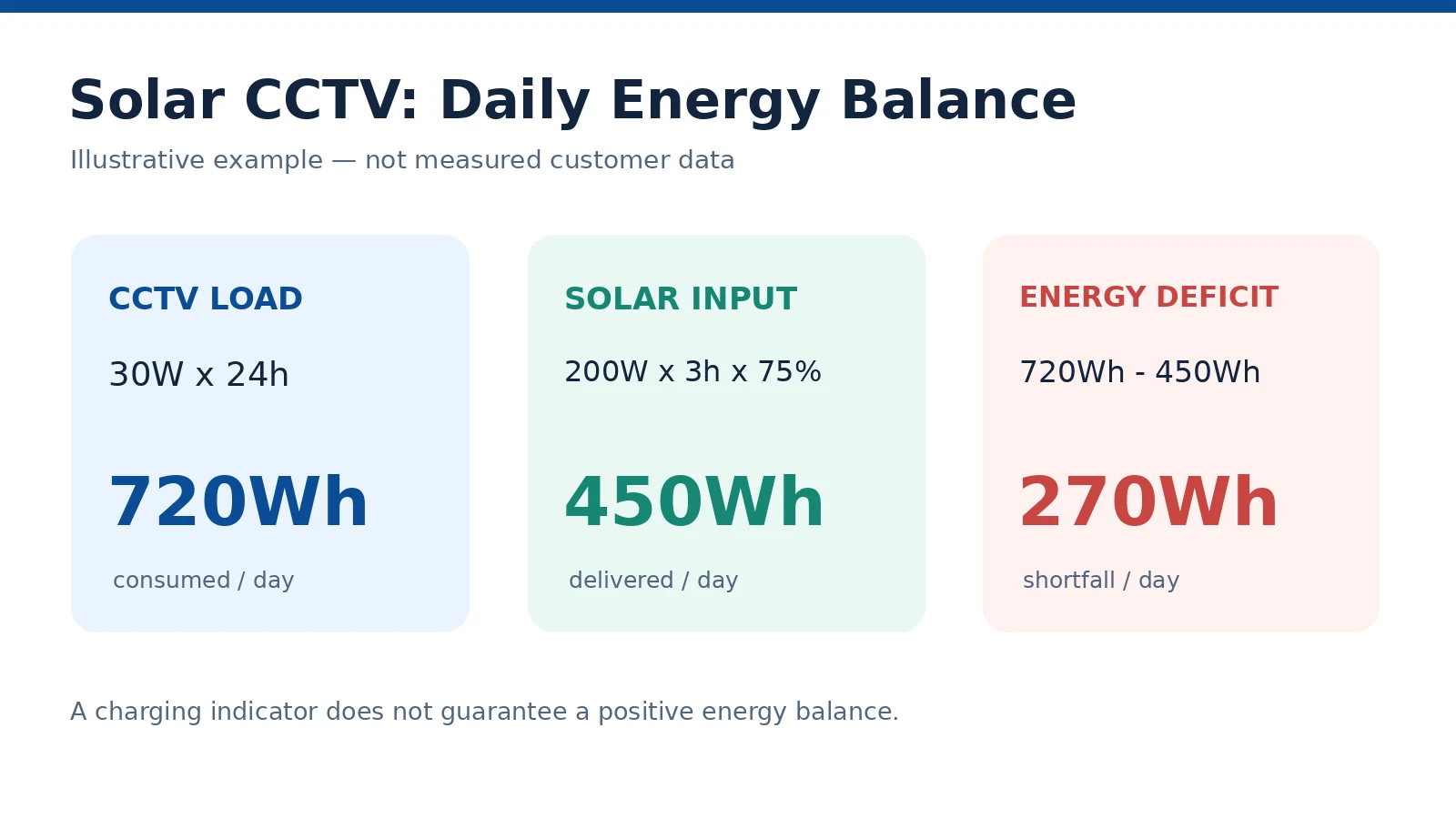
This calculation assumes a consistent average equipment load and solar-energy input. Actual operating results depend on weather, battery usable energy, charging limits, temperature and protective settings.
5. Will a Larger LiFePO4 Battery Solve the Problem?
Increasing battery capacity can extend the period during which a surveillance system operates without adequate solar generation.
However, larger battery capacity does not increase the amount of solar energy available each day.
Scenario A: Temporary Solar Shortage
The solar array normally generates sufficient energy, but the installation must operate through several cloudy or rainy days.
Additional usable battery capacity may help meet the required autonomy. The charging system must also be capable of restoring the depleted energy within an acceptable recovery period.
Scenario B: Persistent Solar Energy Deficit
The system regularly consumes more energy than its solar array can deliver, even during expected operating conditions.
A larger battery may delay shutdown, but its stored energy will continue declining unless generation increases or equipment consumption decreases.
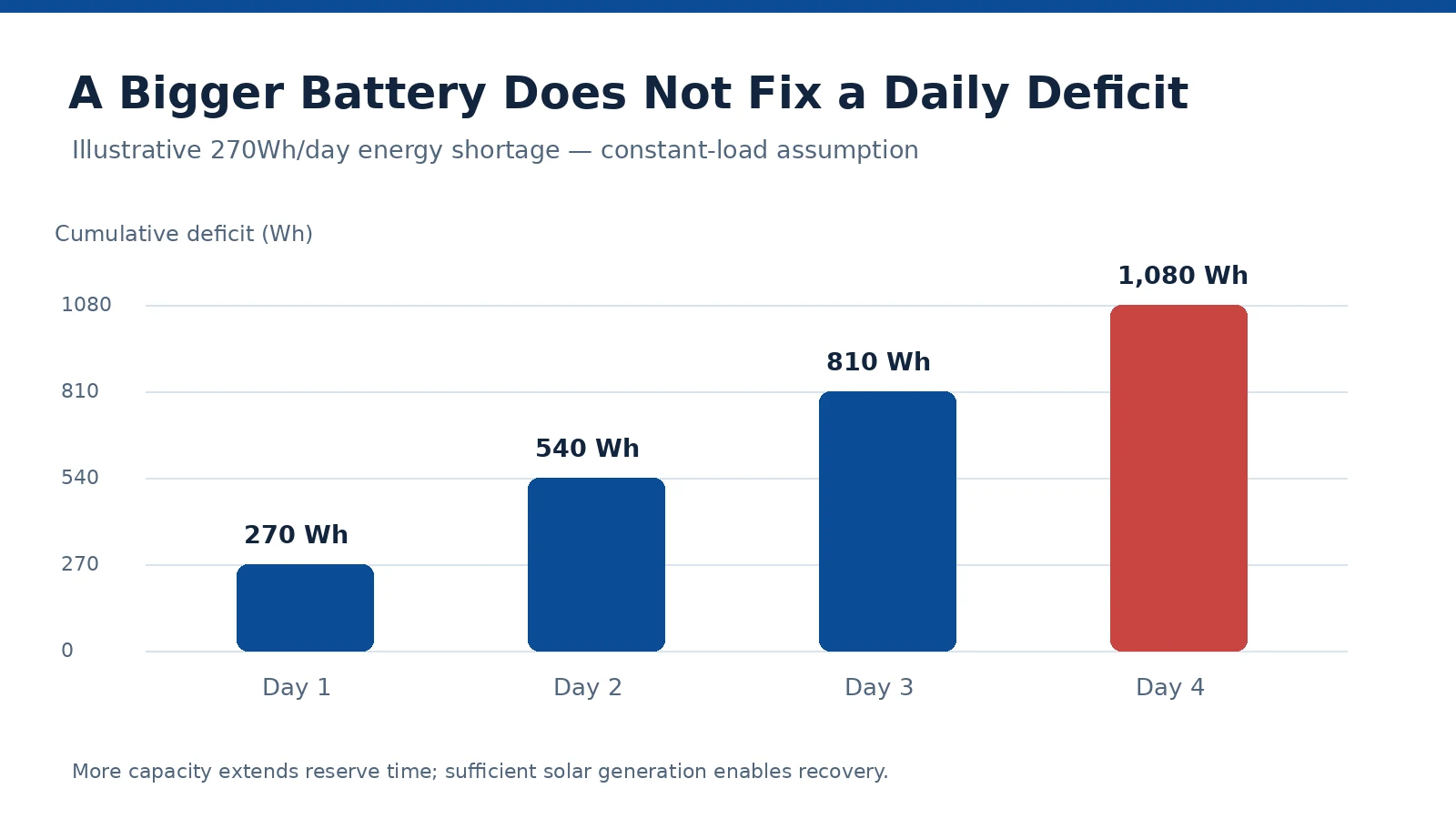
Possible engineering responses include increasing solar-generation capacity, improving panel positioning, reducing equipment consumption and revising operating schedules.
Design decision: Establish whether the problem is insufficient autonomy, insufficient solar generation or a combination of both before changing the battery specification.
6. Check the Solar Charge Controller Before Replacing the Battery
An unsuitable solar charge controller or incorrect charging parameters can prevent a LiFePO4 battery from receiving the intended energy, even when sunlight is available.
For systems originally designed around AGM or GEL batteries, the following items should be verified:
- Charge-controller manufacturer and model
- Supported battery chemistry
- Bulk and absorption charging voltage
- Float-charging behavior, where applicable
- Whether lead-acid equalization is enabled
- Temperature-compensation settings
- Maximum charging current
- Low-voltage disconnect and reconnect settings
- Controller and battery operating-voltage compatibility
LiFePO4 charging parameters must match the selected battery specification.
A built-in BMS does not automatically make a battery compatible with an existing solar charge controller. The BMS provides battery protection, while the charging equipment must operate within the permitted voltage, current and temperature limits.
7. Can Cold Weather Prevent Solar Battery Charging?
Outdoor surveillance installations may experience conditions in which battery discharge is permitted but charging is restricted.
For example, a solar panel may receive useful sunlight during a cold morning while the battery remains below its permitted charging temperature.
Depending on the cell specification and BMS configuration, charging may be restricted or disabled until the battery reaches a suitable temperature.
Cold-climate applications should confirm:
- Minimum permitted battery charging temperature
- Low-temperature charging-protection behavior
- Whether a heated battery configuration is required
- Energy consumption associated with battery heating
- Battery enclosure temperature and environmental exposure
Do not assume that an IP-rated enclosure automatically provides suitable low-temperature charging capability.
8. How Much Solar Power Is Needed to Recover the Battery?
The solar array must support ongoing equipment consumption and, where required, provide additional energy to recover from extended periods of poor weather.
Illustrative Recovery Calculation
Assume the following design conditions:
- Daily equipment energy demand: 720Wh
- Additional energy to restore: 1,080Wh
- Target recovery period: 3 days
- Equivalent peak sun hours: 3 hours/day
- Assumed overall delivery factor: 75%
Additional recovery energy required per day:
1,080Wh ÷ 3 = 360Wh/day
Total required daily delivered energy:
720Wh + 360Wh = 1,080Wh/day
Preliminary solar-panel rating:
1,080Wh ÷ (3h × 0.75) = 480W
The calculated 480W is an illustrative energy-budget result, not a final solar-panel recommendation.
The calculation assumes a consistent energy-accounting boundary and does not replace a seasonal solar assessment.
Actual equipment selection must verify controller ratings, solar-panel configuration, battery charging acceptance, voltage compatibility, weather variation, installation losses and operating reserves.
9. Troubleshooting: Which Component Should Be Checked First?
Different symptoms can indicate different causes. Battery replacement should not be the default first response.
| Observed Condition | Recommended Investigation |
|---|---|
| Battery SOC decreases daily | Solar generation versus total daily equipment consumption |
| System shuts down after cloudy days | Usable battery energy, autonomy and recovery capacity |
| Battery does not fully recharge | Controller settings, solar input and charging limits |
| Charging stops during cold mornings | Battery temperature and BMS low-temperature protection |
| Shutdown during high-power operation | Peak current, BMS settings, cable sizing and voltage drop |
| SOC readings seem inconsistent | SOC estimation, calibration and measured energy flow |
These observations are diagnostic starting points, not confirmed failure causes.
For reliable troubleshooting, record battery voltage, charging current, discharge current, equipment power consumption, battery temperature and controller operating status.
10. LiFePO4 Battery Configurations for Solar CCTV Equipment
MANLY Energy supports LiFePO4 battery configurations for fixed solar CCTV equipment, mobile surveillance towers and larger security trailers.
Depending on the confirmed electrical and mechanical requirements, starting platforms may include:
- 12.8V 30–50Ah: Compact solar CCTV equipment
- 12.8V 100–200Ah: Mobile surveillance applications
- 25.6V 100–200Ah: Larger DC surveillance systems
- 51.2V 100–200Ah: Higher-energy security trailer applications
These capacities are configuration starting points, not automatically compatible replacements or final recommendations for individual installations.
12.8V 30Ah / 384Wh Compact LiFePO4 Battery
The following MANLY 12.8V 30Ah battery uses a blue PVC-wrapped construction with output wires.
This physical configuration provides an example of a compact battery platform that can be evaluated for space-constrained DC equipment.
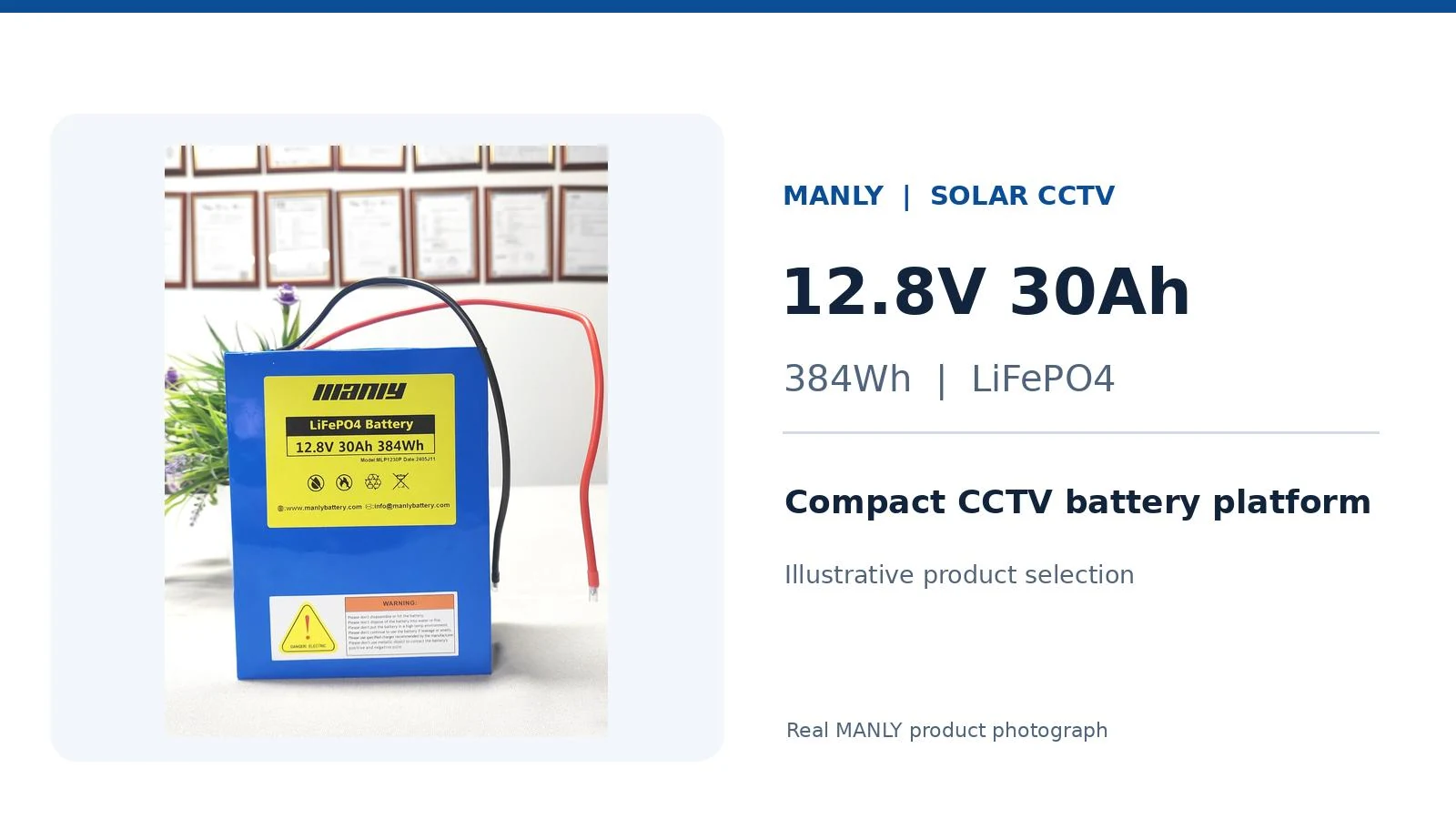
The battery's actual suitability must be confirmed against system voltage, discharge current, charging conditions, physical dimensions and environmental requirements.
12.8V 100Ah / 1,280Wh LiFePO4 Battery
A 12.8V 100Ah battery provides a nominal energy capacity of 1,280Wh and may be considered for applications that require greater stored energy.
However, larger nominal capacity does not guarantee the required operating autonomy.
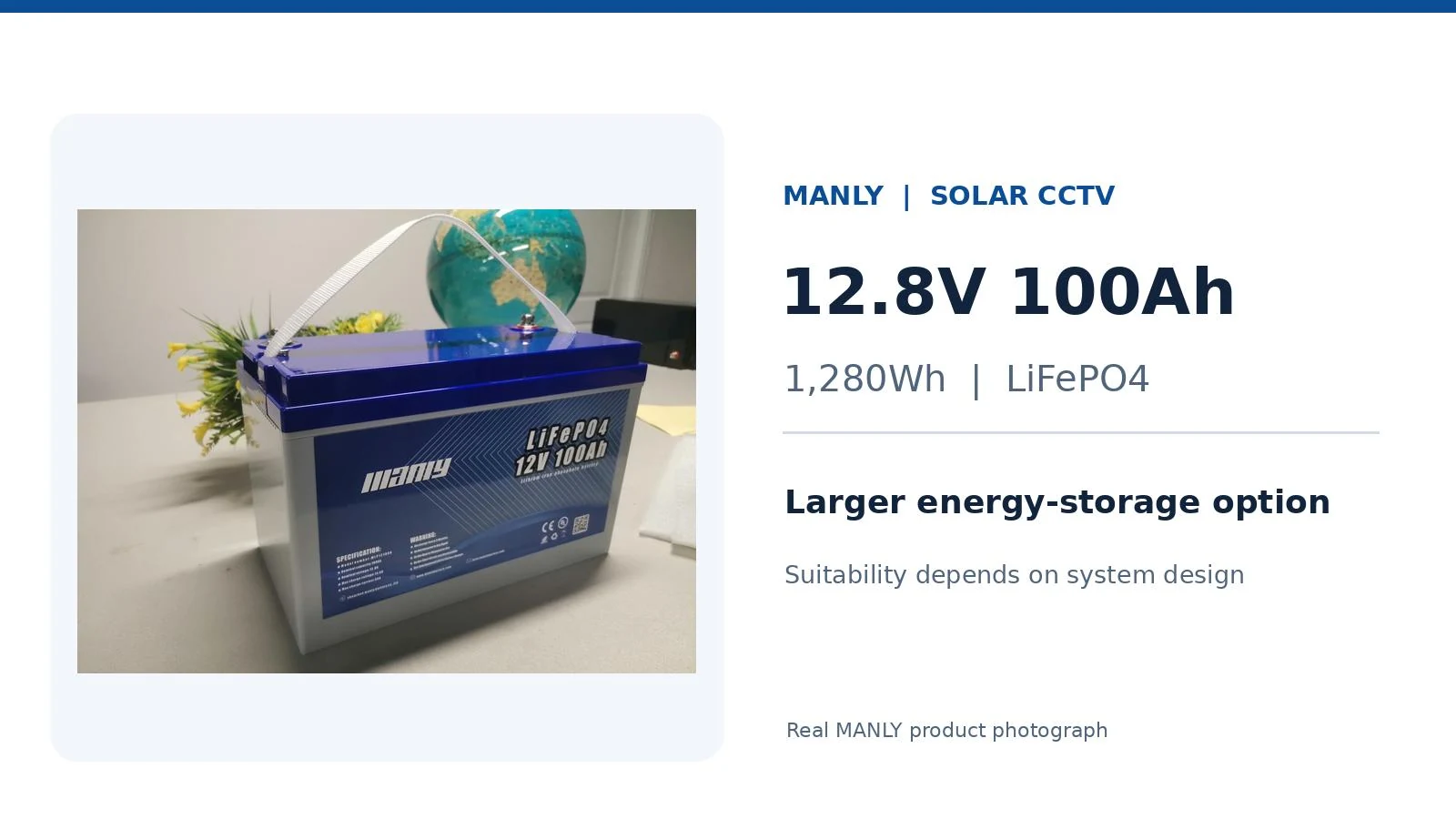
Selection must consider usable energy, charging availability, continuous and peak current, BMS limitations, installation space and the required battery recovery period.
Explore MANLY Solar CCTV & Mobile Surveillance Battery Solutions for relevant battery platforms and application considerations.
11. What Information Should an OEM or System Integrator Provide?
Before finalizing a solar CCTV battery configuration, equipment manufacturers and integrators should prepare the following information:
- Application: Fixed solar CCTV installation, mobile surveillance tower or security trailer
- System voltage: Nominal voltage and acceptable operating range
- Equipment consumption: Daytime, nighttime and peak loads
- Solar array: Panel wattage, quantity and configuration
- Charge controller: Brand, model and relevant charging settings
- Autonomy: Required operating time during insufficient sunlight
- Recovery: Required recharge time after extended poor weather
- Battery installation: Available space, mounting and wiring requirements
- Environment: Location, operating temperatures and enclosure conditions
- Procurement: Estimated quantity, target market and required documentation
These details enable a more useful battery-selection review than capacity alone.
12. Before Increasing Battery Capacity: Final Engineering Checklist
Separate the battery-selection decision into six questions:
- How much energy does the complete surveillance system consume every day?
- How much usable solar energy can the installation generate during its design period?
- How much usable battery reserve is required for the autonomy target?
- Can the solar system restore depleted energy within the expected recovery period?
- Are the controller and charging parameters suitable for the selected LiFePO4 battery?
- Do electrical limits, temperature range, dimensions and environmental protection meet the equipment requirements?
A battery may have sufficient nominal capacity but still run low when solar energy generation is inadequate.
Conversely, a correctly sized solar array does not eliminate the need for sufficient usable battery reserve during poor weather.
For reliable commercial surveillance operation, the battery, solar panels, controller and equipment load should be evaluated as one integrated power system.
Is Your Solar CCTV Battery Running Low Despite Charging?
Share your surveillance equipment load, solar panel rating, charge-controller model, required autonomy and operating conditions with MANLY Energy.
Our team can review the battery requirements and identify the technical parameters that need confirmation before selecting a configuration for your commercial surveillance equipment.