
BATTERY KNOWLEDGE
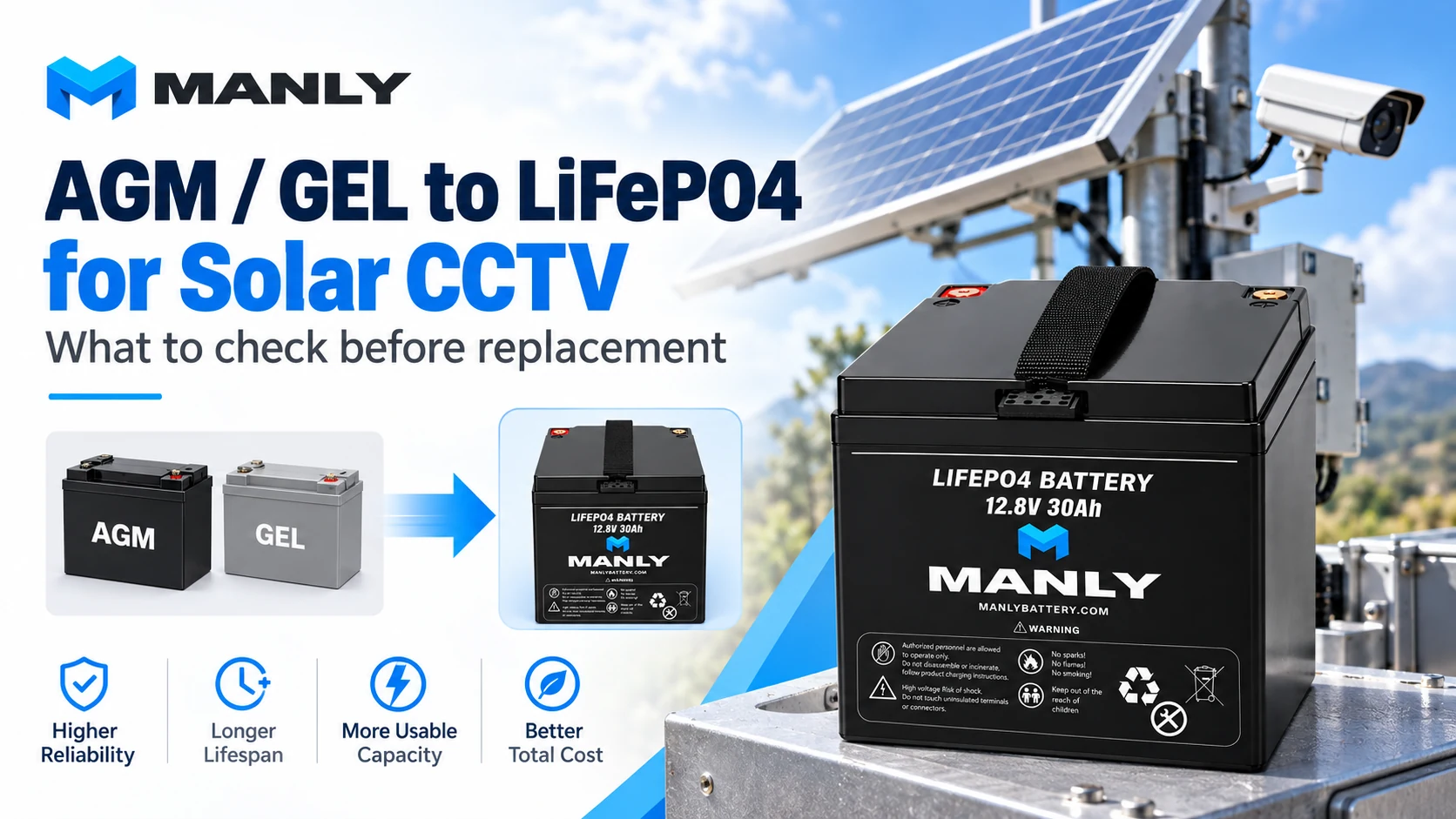
Can You Replace an AGM or GEL Solar CCTV Battery with LiFePO4?
Replacing an AGM or GEL battery in a solar CCTV system requires more than matching voltage and capacity. Review charger settings, LVD, BMS protection and installation requirements before upgrading to LiFePO4.
Published 2026-10-13An AGM or GEL battery in a solar CCTV system may have the same nominal voltage as a proposed LiFePO4 replacement, but that does not guarantee compatibility. The solar charge controller, low-voltage disconnect settings, charging behavior and battery protection limits may all affect the conversion.
For CCTV equipment manufacturers and system integrators, the most important decision is whether the existing power system can safely accommodate LiFePO4 without changing its charging or protection architecture.
This guide focuses on converting existing solar surveillance equipment rather than designing a new system from scratch.
1. Can an Existing AGM or GEL Solar CCTV Battery Be Replaced with LiFePO4?
Potentially, yes. However, a successful replacement depends on more than matching the nominal voltage printed on the battery label.
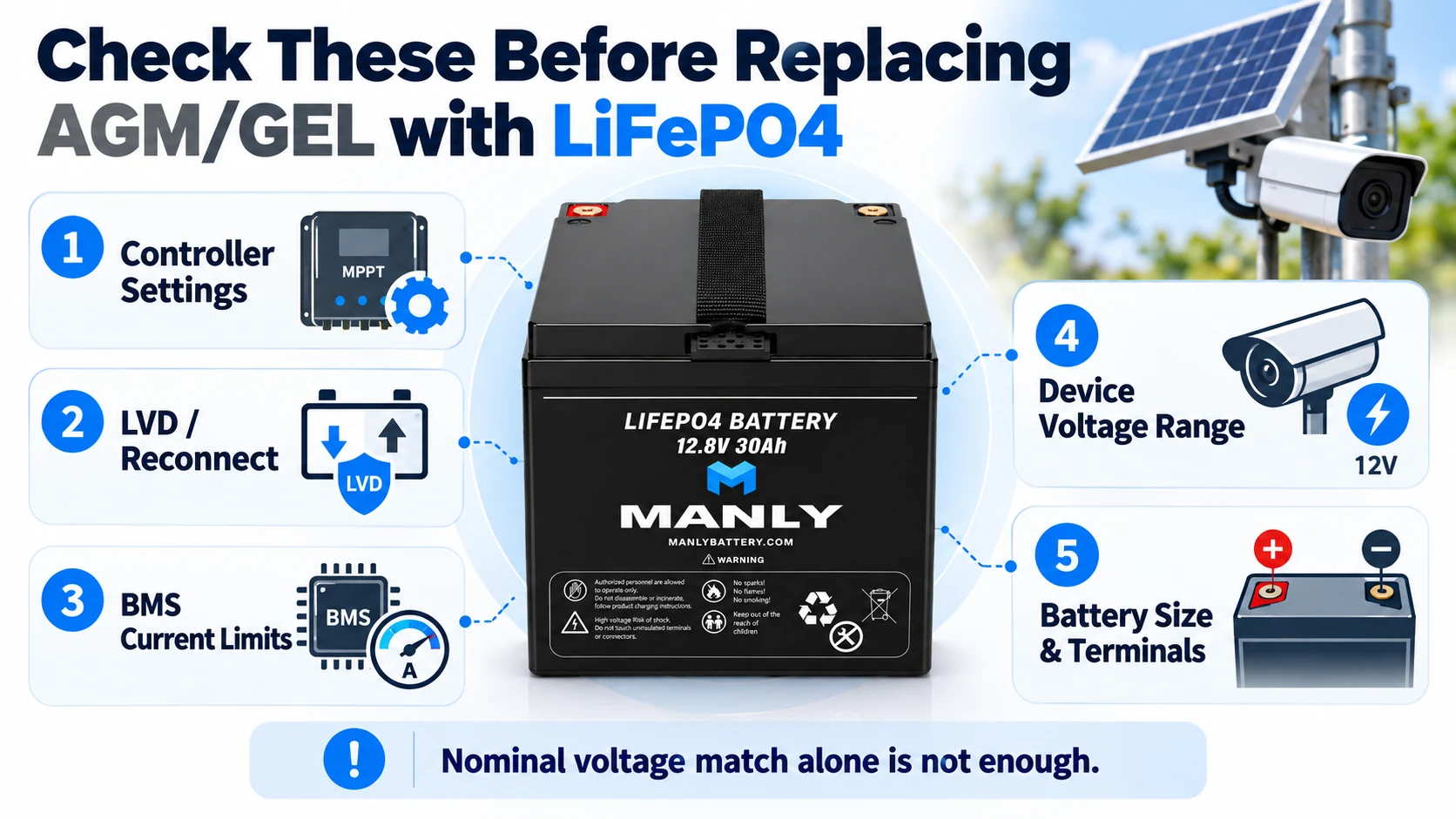
Before approving a LiFePO4 conversion, verify five areas:
- Electrical: Operating voltage range, continuous load and peak current.
- Charging: Solar controller settings and battery charging limits.
- Protection: Low-voltage disconnect, BMS behavior and system restart requirements.
- Mechanical: Battery dimensions, terminals, cable routing and mounting.
- Environmental: Charging temperature, enclosure conditions and outdoor exposure.
If any of these areas cannot be verified, the battery should be treated as a proposed replacement requiring technical review rather than an approved drop-in alternative.
2. Why Matching 12V or 24V Is Not Enough
Many existing surveillance installations use 12V-class or 24V-class lead-acid battery systems.
A nominal 12V AGM or GEL battery and a 12.8V LiFePO4 battery may operate within some of the same equipment voltage ranges. However, their charging behavior, discharge curves and protection requirements differ.
For a 24V-class system, a 25.6V LiFePO4 configuration may be considered, but the same compatibility checks still apply.
| System Parameter | What Must Be Checked |
|---|---|
| Nominal system voltage | The intended battery voltage class |
| Operating voltage range | Camera, router, controller and converter limits |
| Charging voltage | Controller charging profile against the selected battery specification |
| Low-voltage cutoff | System shutdown threshold and restart behavior |
| Current limits | Normal loads, startup loads and BMS ratings |
Nominal voltage alone cannot establish whether the power electronics can operate correctly across the battery's actual charging and discharging range.
3. Check the Existing Solar Charge Controller
The charge controller is often the first component that requires review in an AGM-to-LiFePO4 conversion.
A controller designed for lead-acid charging may use parameters that are unsuitable for a particular LiFePO4 battery configuration.
Review the following settings:
- Bulk and absorption charging voltage
- Absorption time and charge termination behavior
- Float voltage, if float charging is used
- Equalization settings
- Temperature compensation
- Maximum charging current
- Restart and recovery behavior after battery protection events
Lead-Acid Equalization
Some lead-acid controllers include an equalization function. That function should not be applied to LiFePO4 unless explicitly permitted by the battery manufacturer's approved charging specification.
Temperature Compensation
Lead-acid temperature-compensated charging settings should not simply be carried over to a LiFePO4 system. Confirm how the controller handles temperature compensation and whether it can be configured appropriately.
Fixed-Profile Controllers
If the existing controller does not permit suitable lithium charging parameters, a controller replacement may be necessary.
Do not assume that a controller is suitable merely because its documentation mentions a lithium battery mode. The actual charging values and operating behavior must match the proposed pack.
4. Low-Voltage Disconnect: A Common Conversion Risk
Solar CCTV systems often use a low-voltage disconnect, or LVD, to protect the power system from excessive battery discharge.
In an existing AGM or GEL installation, LVD settings may be based on lead-acid discharge characteristics.
When LiFePO4 is installed, the original disconnect and reconnect thresholds may produce undesirable behavior.
Possible outcomes include:
- Equipment disconnecting before the desired usable energy has been delivered
- The system relying on battery BMS protection as its normal shutdown control
- Unexpected restart behavior after solar charging resumes
- Repeated controller or load reconnect attempts
The LVD should be configured according to the equipment voltage requirements and the selected battery's approved operating limits.
Important: A battery BMS should not be treated as a substitute for deliberate system-level energy management.
5. Why the BMS Must Be Matched to the CCTV Equipment
LiFePO4 battery packs normally include a battery management system that monitors and protects the cells.
However, the presence of a BMS does not automatically establish compatibility with every surveillance installation.
Confirm:
- Maximum continuous discharge current
- Permitted peak discharge current and duration
- Maximum charging current
- Over-voltage and under-voltage protection behavior
- Low-temperature charging protection
- Protection recovery and restart behavior
A solar CCTV installation may have modest average consumption but still experience short-duration current peaks during startup or when auxiliary equipment is activated.
The battery's continuous and peak current capability must be reviewed against the actual system load profile.
6. Will the Existing CCTV Equipment Work Across the LiFePO4 Voltage Range?
A CCTV system may include cameras, routers, communication modules and converters with different acceptable input-voltage ranges.
Some devices are powered directly from the battery. Others operate through voltage regulators or DC-DC converters.
For each connected device, verify:
- Minimum permitted input voltage
- Maximum permitted input voltage
- Whether the device is battery-fed or regulated
- Startup and transient current requirements
- Behavior during battery charging and shutdown
For equipment that requires tightly regulated power, retaining or adding suitable DC-DC conversion may be necessary.
This decision should be based on the equipment manufacturer's electrical specifications rather than nominal battery voltage alone.
7. Can You Keep the Existing Battery Enclosure and Wiring?
Electrical compatibility is only one part of the conversion.
Battery dimensions may appear suitable while terminal arrangement, wiring direction or mounting provisions prevent installation.
Check:
- Usable compartment dimensions
- Battery enclosure type and installation orientation
- Terminal location and connection style
- Existing cable length and routing
- Fuse and cable ratings
- Mounting and vibration requirements
- Moisture exposure and enclosure protection
A battery with the same nominal voltage and similar dimensions should not be described as a direct mechanical replacement until the complete installation has been checked.
8. What Changes for Outdoor and Cold-Weather Installations?
A solar surveillance installation may remain exposed to low temperatures for extended periods.
The charging-temperature limits of LiFePO4 batteries may differ from the conditions tolerated by the previous lead-acid configuration.
A cold morning may provide useful solar energy while the battery remains below its permitted charging temperature.
Depending on the pack design, the BMS may restrict charging. Some projects may therefore require thermal management or a heating configuration.
Before conversion, confirm:
- Expected minimum enclosure temperature
- Battery charging-temperature limits
- Available solar charging time in winter
- Energy consumed by any heating system
- Protection and restart behavior after cold conditions
Outdoor suitability should be assessed at the complete installation level. A battery enclosure alone does not establish the protection of the entire system.
9. Example: Comparing Nominal Battery Energy
Illustrative comparison only. These calculations show nominal energy and do not represent verified runtime, usable capacity or interchangeability in a customer installation.
Nominal battery energy is calculated as:
Energy (Wh) = Nominal Voltage (V) × Capacity (Ah)
| Battery Configuration | Nominal Energy |
|---|---|
| 12.8V 30Ah LiFePO4 | 384Wh |
| 12.8V 50Ah LiFePO4 | 640Wh |
| 12.8V 100Ah LiFePO4 | 1,280Wh |
These values do not establish whether one LiFePO4 capacity is equivalent to a particular AGM or GEL battery in real operation.
Lead-acid usable energy depends on discharge rate, operating conditions, depth of discharge and ageing. LiFePO4 usable energy also depends on the selected pack's operating limits and conditions.
For replacement projects, compare the actual required usable energy rather than simply matching ampere-hours.
10. When Is a Controller Replacement Necessary?
Retaining the original solar controller may be reasonable when it supports the required battery voltage, charging parameters, current limits and protection behavior.
Controller replacement or system modification should be considered when:
- Suitable LiFePO4 charging parameters cannot be configured
- Lead-acid equalization or compensation cannot be disabled where necessary
- Charge current exceeds the proposed battery's approved limits
- LVD and reconnect behavior cannot be adapted to the battery
- The system cannot recover correctly from battery-protection events
Changing the battery without reviewing these conditions can leave the original integration problem unresolved.
11. A Practical Solar CCTV Battery Replacement Checklist
Before replacing an AGM or GEL battery with LiFePO4, review the following five areas: solar controller settings, low-voltage disconnect, BMS current limits, equipment voltage range and physical battery fit.
| Check | Decision Required |
|---|---|
| System voltage | Verify the entire operating-voltage range |
| Solar controller | Retain with verified settings, reconfigure or replace |
| LVD settings | Verify shutdown and restart thresholds |
| BMS limits | Compare charge, discharge and peak-current requirements |
| Battery size | Confirm available space, terminals and cable routing |
| Outdoor temperature | Confirm charging limits and heating requirements |
| Required runtime | Calculate usable energy against measured load |
A technically suitable replacement should satisfy all applicable requirements, not just one or two.
12. MANLY LiFePO4 Configurations for Solar CCTV Equipment
MANLY Energy supports LiFePO4 battery configurations for compact solar CCTV installations, mobile surveillance towers and larger security equipment.
For 12V-class surveillance systems, 12.8V LiFePO4 configurations may provide a starting point for engineering review.
12.8V 30Ah LiFePO4 Battery with ABS Housing
The following product illustration is based on a MANLY 12.8V 30Ah LiFePO4 battery design with a black rigid ABS enclosure, top terminals and a carrying strap.
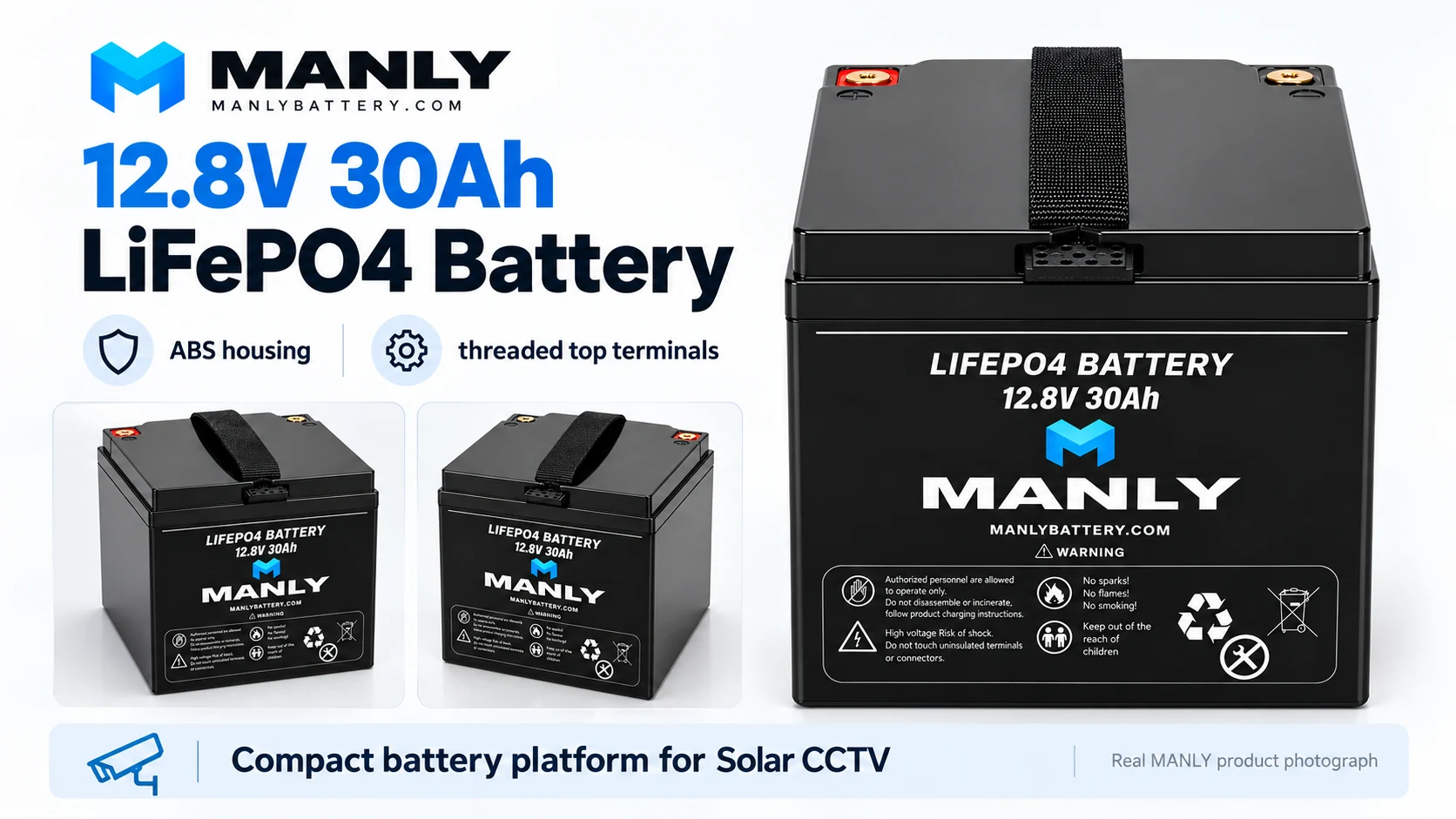
Terminal positioning, battery dimensions, connection requirements and charging behavior must be confirmed against the customer's existing equipment before the battery can be considered a suitable replacement.
Confirmed Singapore CCTV Battery Project
A documented MANLY Singapore CCTV project included two 12.8V 30Ah LiFePO4 battery constructions:
- An ABS-housed configuration with M6 terminals
- A blue PVC-wrapped configuration with positive and negative output wires
Both configurations have 384Wh nominal energy. They illustrate different mechanical arrangements, not proven replacements for any specific AGM or GEL battery.
The documented project does not establish the customer's previous battery chemistry, controller model or conversion process.
Read the Singapore CCTV Battery Project for the confirmed battery configurations and mechanical details.
For larger energy requirements and other voltage platforms, explore MANLY Solar CCTV & Mobile Surveillance Battery Solutions.
13. What Information Should You Provide Before Conversion?
For equipment manufacturers, installers and system integrators planning an AGM/GEL-to-LiFePO4 conversion, the following information helps determine whether the existing architecture can be retained:
- Existing AGM or GEL battery voltage and capacity
- Battery manufacturer, model and datasheet
- Solar charge-controller make and model
- Current charging voltage and controller settings
- Controller LVD and reconnect thresholds
- Camera, router and auxiliary equipment power requirements
- Continuous and peak current
- Required battery autonomy
- Battery compartment dimensions
- Terminal and wiring arrangement
- Operating temperature and installation conditions
- Expected project quantity and target market
Photographs of the current battery installation, controller label and wiring arrangement can also help identify mechanical or electrical constraints before a replacement configuration is proposed.
14. Final Decision: Battery Replacement or System Retrofit?
There are three possible outcomes after a compatibility review.
Outcome A: Retain the Existing Architecture
The existing equipment, controller and system protection can accommodate the proposed battery within verified operating limits. Only the approved battery and installation changes are required.
Outcome B: Reconfigure Selected Components
The system can support LiFePO4 after adjustments to controller settings, low-voltage protection or other identified parameters.
Outcome C: Redesign Part of the Power System
Existing charging, protection or voltage requirements cannot be safely matched to the proposed battery. Controller replacement or a broader power-system modification is necessary.
For commercial CCTV equipment, this decision should be based on documented component specifications and testing rather than nominal battery voltage alone.
Planning an AGM or GEL Battery Replacement for Solar CCTV Equipment?
Send MANLY Energy your existing battery specification, solar controller model, system voltage, equipment load and available battery space.
Our team can review which electrical and mechanical requirements must be confirmed before selecting a LiFePO4 configuration for your equipment.