
BATTERY KNOWLEDGE
12V vs 24V vs 48V for Solar CCTV: Which Voltage Should You Choose?
A higher battery voltage can reduce DC current, but it does not automatically make a solar CCTV system more efficient or compatible. Compare 12V, 24V and 48V architectures using load power, cable length, controllers and equipment voltage requirements.
Published 2026-10-15A solar CCTV manufacturer may consider moving from a 12V battery system to 24V or 48V because its equipment requires more power, longer DC cable runs or additional surveillance devices. Higher battery voltage can reduce current for the same electrical load, but it does not automatically provide longer runtime or make the complete system more efficient.
The decision affects the battery, solar charge controller, DC-DC converters, wiring, circuit protection and the input-voltage ranges accepted by the cameras and communication equipment.
For CCTV equipment manufacturers, mobile surveillance tower builders and off-grid system integrators, the objective is to select a practical voltage architecture for the complete equipment system rather than choosing the highest available battery voltage.
1. Should a Solar CCTV System Use 12V, 24V or 48V?
The appropriate battery voltage depends on the actual equipment load, power-distribution architecture and component compatibility.
A compact remote camera installation may operate effectively with a 12V-class system. A larger mobile surveillance tower may benefit from a 24V-class distribution system when its total load or cable length creates higher current. A 48V-class architecture may be considered for equipment with greater power requirements or an existing compatible 48V DC system.
None of these voltage classes is universally better for every CCTV installation.
| Voltage Class | Design Consideration | Main Verification |
|---|---|---|
| 12V Class | Compact, relatively low-power CCTV installations | Load current, cable sizing and device input voltage |
| 24V Class | Larger DC loads, longer cable runs or equipment designed for 24V | Solar controller and DC-DC converter compatibility |
| 48V Class | Higher-power systems with a suitable DC architecture | Full voltage range, protection and system integration |
These are preliminary architecture considerations rather than fixed power thresholds or approved battery recommendations for a particular CCTV installation.
2. Why Higher Battery Voltage Reduces DC Current
For the same electrical power, increasing the supply voltage reduces the required current.
The simplified relationship is:
Current (A) = Power (W) / Voltage (V)
Illustrative Example: A 240W DC Load
Consider the same idealized 240W load operating at three different nominal battery voltages.
| Battery Voltage | Calculation | Current |
|---|---|---|
| 12.8V | 240W / 12.8V | 18.75A |
| 25.6V | 240W / 25.6V | 9.38A |
| 51.2V | 240W / 51.2V | 4.69A |
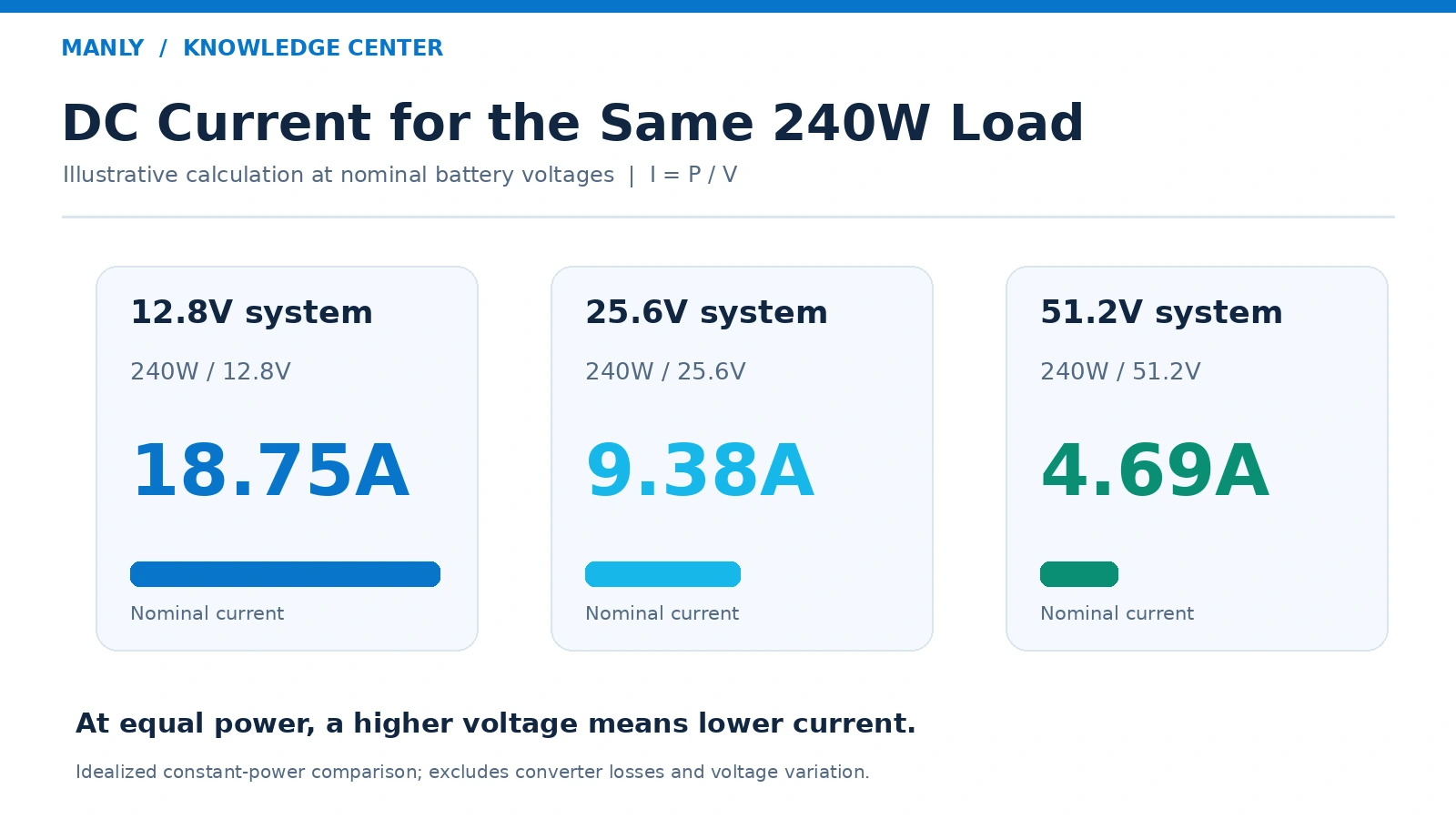
At the same nominal power, a 25.6V supply requires approximately half the current of a 12.8V supply. A 51.2V supply requires approximately one-quarter of the 12.8V current.
This can influence cable cross-section, connector ratings and resistive losses in the DC distribution system.
Engineering limitation: These calculations use nominal voltage and an idealized constant-power load. Actual current must be evaluated across the battery's operating-voltage range and must include applicable converter losses and transient loads.
3. How System Voltage Affects Cable Losses
DC wiring losses depend on the current flowing through the conductors and the total circuit resistance.
The basic relationship is:
Power Loss (W) = Current² (A²) × Resistance (Ω)
For the same delivered power and conductor resistance, reducing current reduces resistive cable losses.
Illustrative Cable-Loss Calculation
Assume the positive and return cable path has a combined resistance of 0.10Ω.
Using the nominal-voltage currents from the previous 240W example:
| Nominal Voltage | Current | Approximate I²R Loss |
|---|---|---|
| 12.8V | 18.75A | 35.16W |
| 25.6V | 9.38A | 8.79W |
| 51.2V | 4.69A | 2.20W |
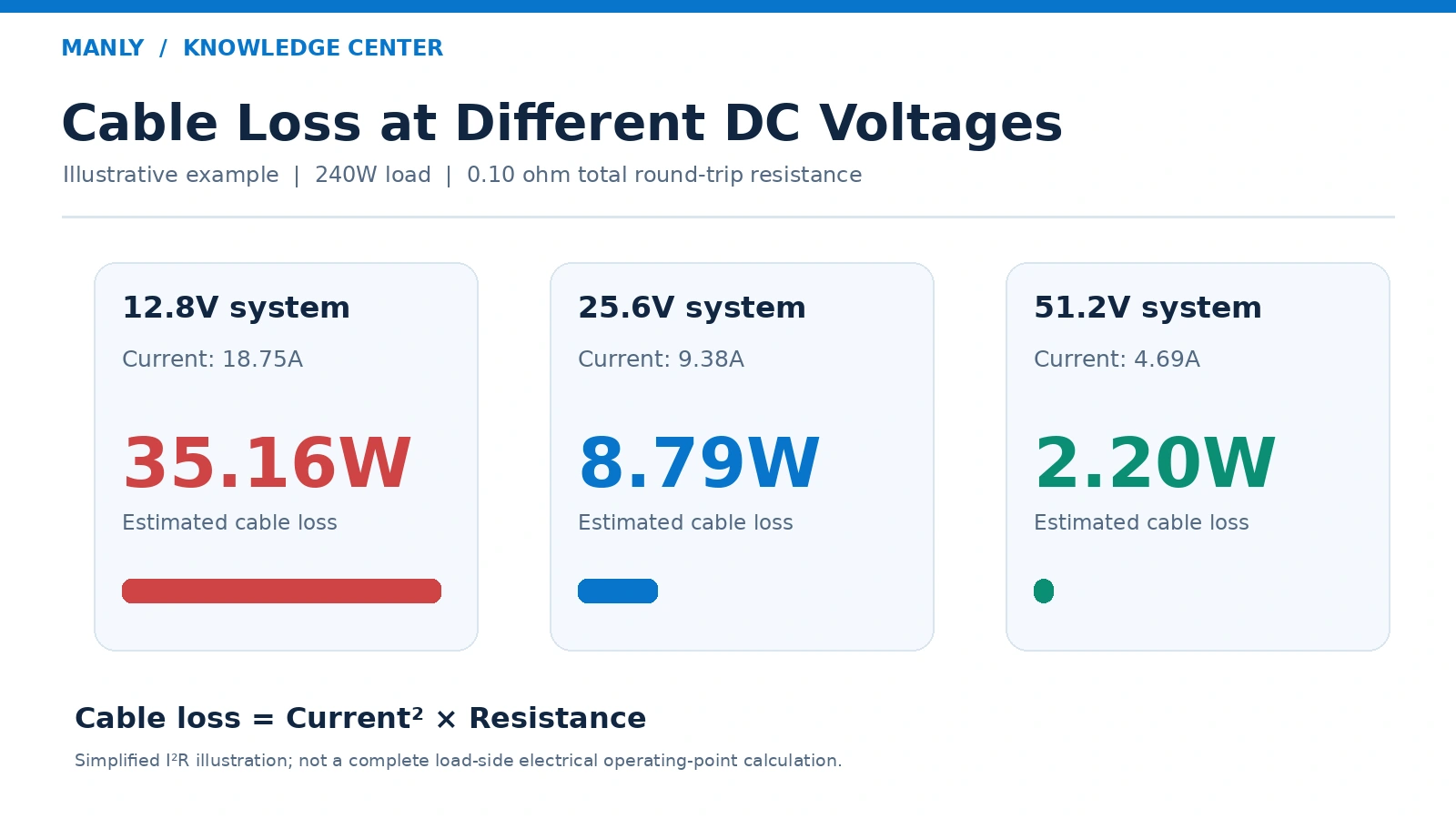
The comparison illustrates why higher voltage may be beneficial for some surveillance systems with long DC wiring or substantial electrical loads.
However, the calculation is simplified. Cable voltage drop changes the actual operating current and load-side voltage, especially in a constant-power system.
For final design, verify conductor size, installation length, current rating, permitted voltage drop, insulation requirements and protective devices.
Higher voltage can reduce cable losses, but it does not guarantee better total system efficiency once DC-DC conversion, equipment behavior and other losses are considered.
4. A 48V Battery Does Not Automatically Provide More Runtime
Battery voltage and battery energy are different specifications.
Nominal stored energy is calculated as:
Nominal Energy (Wh) = Nominal Voltage (V) × Rated Capacity (Ah)
Illustrative Energy Comparison
- 12.8V × 100Ah = 1,280Wh
- 25.6V × 50Ah = 1,280Wh
- 51.2V × 25Ah = 1,280Wh
These hypothetical battery configurations have different voltages and amp-hour capacities but the same nominal energy.
Under identical usable-energy and overall-efficiency assumptions, they may support similar total energy demand.
Actual runtime depends on usable depth of discharge, temperature, conversion efficiency, BMS limits and the equipment load profile.
Therefore, increasing battery voltage alone does not increase autonomy.
For more information on energy reserve during low-sun conditions, read How Much Battery Autonomy Does a Solar CCTV System Need?
5. Can a 24V or 48V Battery Power a 12V CCTV Camera?
Not necessarily directly.
Some CCTV cameras are designed for regulated 12V DC input, while other devices accept wider voltage ranges or use different power-delivery methods.
If a device requires regulated 12V input, connecting it to a 25.6V or 51.2V battery may require a correctly specified DC-DC converter.
Before selecting the converter, verify:
- Camera manufacturer and exact model
- Minimum and maximum permitted input voltage
- Nominal operating power and peak load
- DC-DC converter input-voltage range
- Converter output-voltage regulation
- Continuous and peak output-current capability
- Converter efficiency and thermal performance
- Startup, shutdown and electrical protection behavior
Do not connect equipment rated only for 12V input directly to a higher-voltage battery unless the equipment manufacturer's documentation explicitly permits that voltage range.
Buyer decision: Before changing the battery voltage, determine whether the existing equipment can use the new voltage directly or requires regulated conversion.
6. How Solar Charge Controllers Affect Voltage Selection
The solar charge controller must support the selected battery voltage, photovoltaic input configuration and battery charging profile.
Moving from a 12V-class battery to a 24V- or 48V-class system may require a different charge controller or changes to the photovoltaic array configuration.
Important checks include:
- Supported nominal battery voltages
- Maximum photovoltaic open-circuit input voltage
- Solar input power limits at the selected battery voltage
- MPPT operating-voltage range, where applicable
- Battery charging-voltage settings
- Maximum charging-current capability
- Low-temperature charging restrictions
- Load-output and low-voltage protection settings
The photovoltaic array must remain within the controller's specified electrical limits, including expected cold-weather open-circuit voltage conditions.
A controller suitable for a 12V battery cannot automatically be assumed suitable for 24V or 48V operation.
7. What Changes When a Mobile Surveillance Tower Uses 24V?
A mobile surveillance tower may contain more electrical equipment than a compact fixed CCTV installation.
Depending on the manufacturer's equipment design, the system may include cameras, routers, recording equipment, lighting, control electronics and auxiliary DC loads.
A 24V-class architecture may help reduce distribution current when the installed equipment supports it or when appropriate voltage conversion is included.
However, changing the battery voltage affects more than the battery itself.
Questions for the Equipment Manufacturer
- Are the main electrical loads designed for 12V or 24V operation?
- Which devices require regulated DC outputs?
- How long are the main DC cable runs?
- What is the maximum simultaneous system load?
- Does any equipment create a significant startup-current peak?
- Can the existing solar charge controller support the new voltage?
- Are the protection devices rated for the selected DC system?
- Will maintenance and servicing procedures need to change?
For a new tower design, voltage selection should be completed alongside the equipment electrical architecture.
For an existing system, a change from 12V to 24V should be treated as a retrofit requiring component-level compatibility verification.
8. When Does a 48V-Class Solar CCTV System Make Sense?
A 48V-class architecture may be considered for higher-power surveillance equipment, larger DC distribution systems or installations already engineered around a compatible 48V platform.
A common 16-series-cell LiFePO4 battery configuration has a nominal voltage of 51.2V, often used in 48V-class systems.
However, nominal voltage is not the complete operating-voltage range.
Before selecting a 51.2V battery platform, review:
- The complete voltage range accepted by connected equipment
- DC-DC converter input and output limitations
- Solar charge-controller compatibility
- Battery continuous and peak current requirements
- Appropriate DC-rated fuses, switches and disconnects
- Cable, connector and insulation requirements
- Applicable safety and installation requirements
- Battery enclosure, mounting and installation space
A higher nominal voltage should not be selected solely because greater battery energy is needed.
Voltage architecture and stored energy should be evaluated as related but separate system requirements.
9. How Voltage Selection Affects Total System Cost
Battery purchase price alone may not identify the most practical or economical electrical architecture for a surveillance OEM.
Higher-voltage distribution may reduce current and some wiring losses, but can also require different controllers, converters, protection hardware or installation procedures.
When comparing system architectures, review:
- Battery configuration and BMS requirements
- Charge-controller specifications
- DC-DC conversion requirements
- Wiring and connector costs
- DC protection components
- Assembly and commissioning requirements
- Replacement parts and maintenance procedures
- Technical documentation and production consistency
For an OEM manufacturing repeated equipment configurations, standardizing the correct voltage architecture can simplify engineering documentation, assembly and servicing.
However, this decision must follow the actual electrical requirements rather than a general preference for higher voltage.
10. MANLY LiFePO4 Battery Platforms for Solar CCTV Equipment
MANLY Energy supports LiFePO4 battery configurations for fixed solar CCTV equipment, mobile surveillance systems and larger security trailers.
Battery voltage should be selected according to the surveillance equipment's electrical architecture, not only the required amp-hour capacity.
Three MANLY Battery Voltage Platforms
The following product comparison illustrates three nominal LiFePO4 battery voltage platforms:
- 12.8V 30Ah: 384Wh nominal energy
- 25.6V 100Ah: 2,560Wh nominal energy
- 51.2V 100Ah: 5,120Wh nominal energy
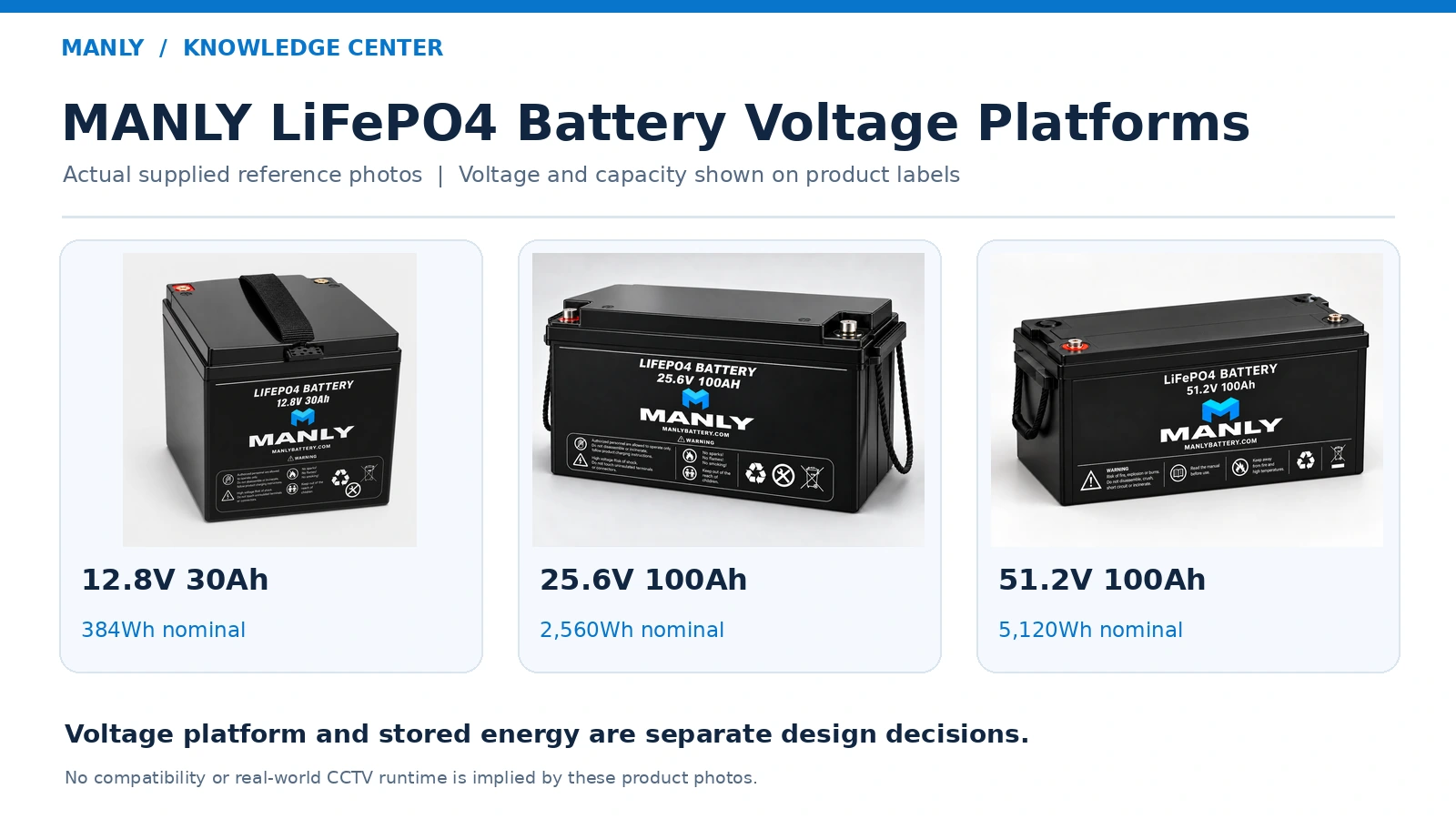
The three batteries do not contain equal amounts of energy, so the comparison should not be interpreted as a runtime comparison between voltage platforms.
Actual system performance depends on equipment load, battery usable energy, charging availability and conversion losses.
Preliminary Battery Configuration Ranges
For surveillance equipment, MANLY can evaluate configuration starting points such as:
- 12.8V 30–50Ah for compact solar CCTV equipment
- 12.8V 100–200Ah for higher-energy mobile surveillance equipment
- 25.6V 100–200Ah for selected larger DC surveillance systems
- 51.2V 100–200Ah for higher-energy equipment designed around an appropriate voltage architecture
These are preliminary configuration ranges, not confirmed replacements or universally compatible models. Final selection requires technical review of the equipment, charging architecture, current limits and installation conditions.
Confirmed Singapore CCTV Project Reference
A documented MANLY CCTV project in Singapore included two 12.8V 30Ah LiFePO4 battery configurations, each providing 384Wh nominal energy.
One configuration used ABS housing with M6 terminals. The other used blue PVC wrapping with positive and negative output wires.
The project confirms the supplied battery configurations and mechanical arrangements. It does not document the customer's camera input-voltage range, solar charge-controller specifications, site electrical load or comparative performance against 24V and 48V systems.
Read the Singapore CCTV Battery Project for verified delivered configurations.
For wider system requirements, explore Solar CCTV & Mobile Surveillance Battery Solutions.
11. What Information Should an OEM Provide Before Choosing System Voltage?
To evaluate a battery voltage platform for a new surveillance product or an existing system upgrade, manufacturers and integrators should provide the following information:
- Equipment application: Fixed CCTV, mobile surveillance tower or security trailer
- Device models: Cameras, routers, recorders and auxiliary equipment
- Input voltage: Permitted voltage range for each device
- Power consumption: Continuous, peak and nighttime loads
- Current architecture: Existing power-distribution arrangement
- Wiring: Main DC cable lengths and cable-size restrictions
- Solar array: Panel specifications and electrical configuration
- Controller: Brand, model and charging capabilities
- Autonomy: Required equipment operating time during insufficient solar input
- Mechanical: Available battery compartment dimensions and mounting requirements
- Environment: Operating temperature and exposure conditions
- Procurement: Expected quantity, target market and required documentation
Electrical diagrams, existing controller datasheets and measured load information are particularly useful when deciding whether to retain the present system voltage or redesign the equipment architecture.
12. Final Decision: Keep 12V, Move to 24V or Engineer a 48V System?
Retaining a 12V-class architecture may be practical when the electrical loads are relatively modest, cable runs are appropriate and the existing devices already operate correctly within the verified voltage range.
Moving to 24V may be worth evaluating when current and wiring losses become significant or when the equipment is already designed around a 24V supply.
A 48V-class architecture may be appropriate for higher-power systems where the equipment, charging system, conversion hardware and electrical protection can be integrated correctly.
The best choice is not necessarily the highest available voltage. It is the voltage architecture that meets the equipment's electrical requirements, energy demand, installation constraints and operating conditions.
Before finalizing the battery specification, verify the complete system voltage range, usable battery energy, solar charging compatibility, current limits, mechanical integration and required autonomy.
Choosing a DC Voltage Platform for Your Surveillance Equipment?
Share your CCTV equipment voltage requirements, continuous and peak loads, solar charge-controller model, wiring arrangement and available battery space with MANLY Energy.
Our team can review the battery configuration requirements and identify the electrical interfaces that need verification before finalizing a 12V-, 24V- or 48V-class surveillance system.