
BATTERY KNOWLEDGE
How Much Battery Autonomy Does a Solar CCTV System Need?
Learn how to determine battery autonomy for a solar CCTV system based on equipment load, solar conditions, required uptime and usable battery energy.
Published 2026-10-06Battery capacity and battery autonomy are related, but they are not the same thing. A 60Ah battery does not automatically mean that a solar CCTV system can operate for one day, two days or any fixed period.
Actual autonomy depends on the total equipment load, system voltage, usable battery energy, operating schedule and the amount of solar charging available under the project’s real operating conditions.
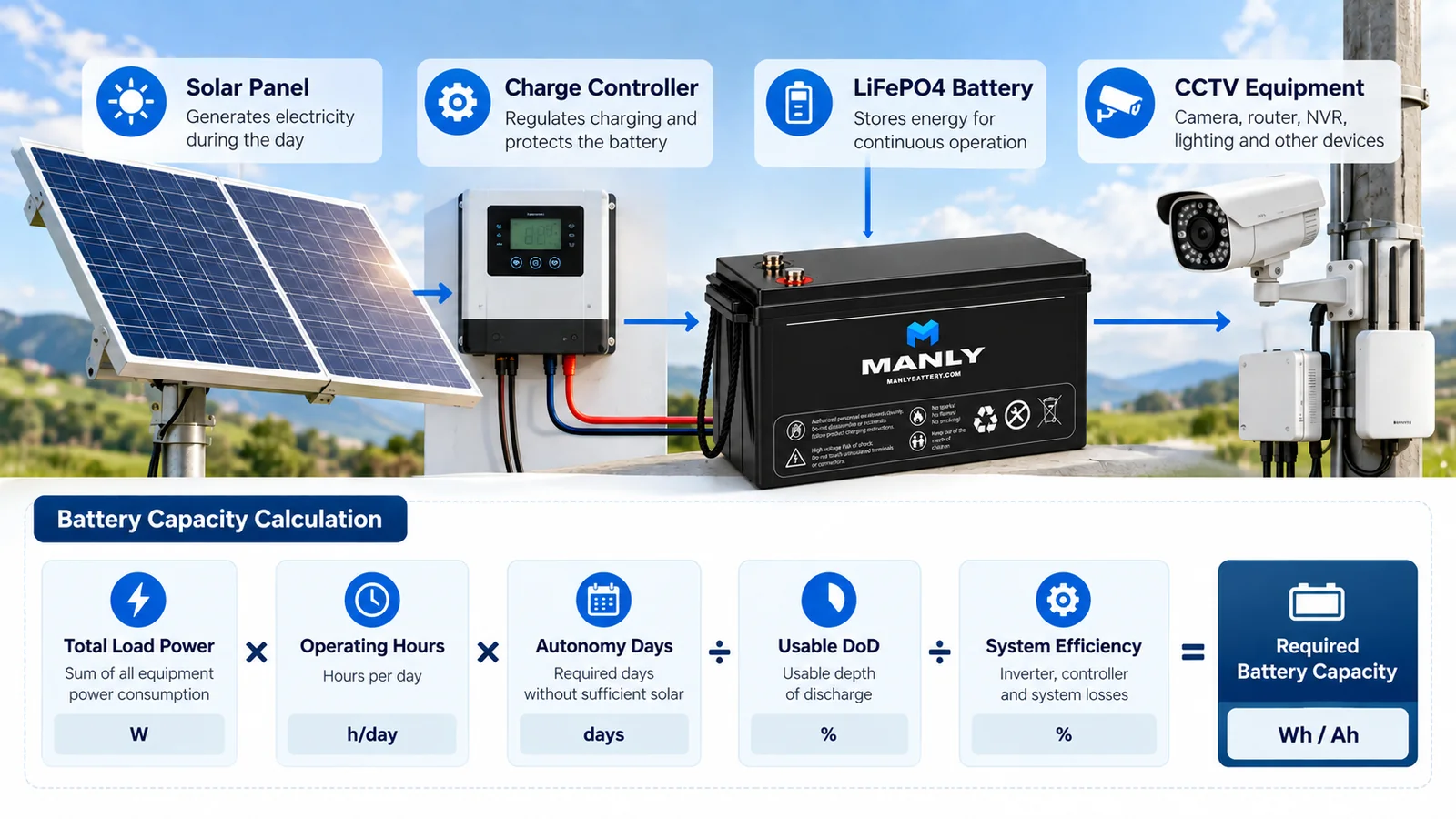
What Does Battery Autonomy Mean?
Battery autonomy is the amount of time a system can continue operating from stored battery energy when useful solar charging is unavailable or insufficient.
For a solar CCTV system, autonomy should be considered together with the daily load profile and expected charging conditions.
For example, a system may be designed to continue operating through one night, one cloudy day, two low-sun days or another project-specific reserve period.
There is no single autonomy target that is correct for every solar CCTV or remote surveillance system.
Why Battery Capacity Alone Does Not Tell You the Runtime
Battery capacity in amp-hours only becomes useful for runtime calculation when the nominal voltage and actual system load are also known.
A 60Ah battery at 12.8V and a 60Ah battery at 25.6V do not contain the same nominal energy.
The nominal battery energy can be estimated using:
Battery Energy (Wh) = Battery Voltage (V) × Battery Capacity (Ah)
For example:
- 12.8V × 60Ah = 768Wh
- 25.6V × 60Ah = 1,536Wh
Even after nominal energy is known, actual available runtime still depends on usable depth of discharge, system efficiency and the equipment load.
What Determines Solar CCTV Battery Autonomy?
The required autonomy should be defined from the actual operating environment rather than from battery capacity alone.
Important factors include:
- Total continuous equipment load
- Daytime and nighttime load differences
- Camera operating schedule
- Router, modem and communication load
- NVR or recorder power consumption
- Infrared lighting or auxiliary lighting
- Local solar conditions
- Seasonal variation
- Site accessibility
- Required system uptime
- Battery charging window
- Temperature conditions
1 Day vs 2 Days vs 3+ Days of Autonomy
Different autonomy targets create different battery and solar-system requirements.
Approximately 1 Day of Autonomy
A one-day reserve may be considered where solar conditions are relatively predictable, the site is easy to access and a short interruption can be tolerated.
This does not mean one day is automatically suitable for every project. The design still has to be checked against seasonal conditions and charging availability.
Approximately 2 Days of Autonomy
A two-day design provides additional stored energy for periods of reduced solar input or temporary charging limitations.
Compared with a one-day design, this typically requires more battery energy and may also require additional solar charging capacity to restore the energy used.
3 Days or More
Longer autonomy may be considered for remote sites, critical surveillance systems or locations where low-sun periods can last longer.
However, increasing autonomy also increases battery size, cost, weight, required installation space and recharge time.
Long autonomy should therefore be justified by the actual site requirements rather than selected automatically.
How to Estimate Battery Autonomy
A simplified battery-side runtime calculation can be expressed as:
Autonomy Hours = Usable Battery Energy (Wh) ÷ Average System Load (W)
Then:
Autonomy Days = Autonomy Hours ÷ 24
Usable battery energy is not necessarily equal to the full nominal battery energy.
A simplified estimate may use:
Usable Battery Energy = Nominal Battery Energy × Usable DoD × System Efficiency
The depth-of-discharge and efficiency values used in a calculation should be treated as design assumptions and confirmed for the actual battery, controller and operating conditions.
Worked Battery Autonomy Example
Consider a simplified example using a 12.8V 60Ah LiFePO4 battery and a continuous 12W system load.
| Design item | Example value |
|---|---|
| Nominal battery voltage | 12.8V |
| Battery capacity | 60Ah |
| Nominal battery energy | 768Wh |
| Example usable DoD | 80% |
| Example system efficiency | 90% |
| Continuous system load | 12W |
Estimated usable battery energy:
768Wh × 0.80 × 0.90 ≈ 553Wh
Estimated battery-only runtime:
553Wh ÷ 12W ≈ 46.1 hours
Estimated autonomy:
46.1 ÷ 24 ≈ 1.9 days
This is a calculation example, not a confirmed battery recommendation for a real CCTV system.
Actual field runtime may differ because of changing loads, temperature, battery protection limits, controller losses and solar charging during operation.
For the full battery-sizing process, see our guide to calculating solar CCTV battery capacity.
Why Oversizing the Battery Is Not Always the Best Solution
It may seem safer to simply install the largest battery that fits, but a larger battery can create new system-level problems.
A larger battery may require:
- More installation space
- Higher project cost
- More weight
- Longer charging time
- More solar panel power
- Higher controller charging capability
If the solar array cannot restore the energy consumed by the system, increasing battery capacity alone does not correct the underlying energy imbalance.
Battery, Solar Panel and Controller Must Be Reviewed Together
Solar CCTV autonomy is not only a battery question.
The complete energy path should be reviewed:
Solar Panel → Charge Controller → Battery → CCTV Load
The solar panel must be able to generate enough energy during the available charging window, while the controller must be compatible with the selected battery voltage and charging profile.
If daily energy consumption is greater than the energy that can be restored by the solar system, battery state of charge will gradually decrease regardless of how large the battery is.
Weather and Seasonal Solar Conditions Matter
Solar availability varies with location, season, panel orientation, shading and weather.
A system that performs well during summer may have a much smaller charging margin during winter or extended cloudy periods.
For this reason, autonomy planning should consider the expected low-sun operating conditions rather than only ideal solar conditions.
Where reliable weather or solar-resource data is available, it can be used as part of the system design review.
Site Accessibility Can Change the Required Autonomy
A system installed near a serviced building may tolerate a different design margin from a surveillance system installed at a remote construction site, roadside location or temporary mobile tower.
When access is difficult or expensive, additional battery reserve may reduce the risk of unnecessary service visits.
For critical security applications, the acceptable interruption time should also be discussed before the final battery capacity is selected.
Nighttime Loads Can Be Higher Than Daytime Loads
Many CCTV systems do not have a perfectly constant 24-hour load.
Night operation may introduce additional power consumption from infrared illumination, auxiliary lighting or other equipment.
If the system has different daytime and nighttime loads, daily energy demand should be calculated from the separate operating periods rather than relying only on a simple average.
Temperature Can Affect Available Battery Energy
Outdoor surveillance equipment may operate across a wide temperature range.
Low temperature can affect battery charging and available energy, while high temperature can influence battery life and enclosure design.
For LiFePO4 systems operating in cold environments, low-temperature charging protection or an optional heating strategy may need to be reviewed.
Temperature requirements should therefore be confirmed together with autonomy requirements.
What Information Is Needed Before Selecting an Autonomy Target?
Before defining the battery reserve for a solar CCTV system, provide the following project information where available:
- System voltage
- Total daytime load
- Total nighttime load
- Operating hours
- Required system uptime
- Preferred autonomy target
- Solar panel specifications
- Charge controller brand and model
- Available battery space
- Minimum and maximum temperature
- Site location or relevant solar conditions
- Estimated project quantity
Singapore CCTV Project Reference
MANLY has supplied two 12.8V 30Ah LiFePO4 battery configurations for a CCTV project in Singapore.
Each battery has a nominal energy of:
12.8V × 30Ah = 384Wh
The project used two different mechanical configurations: an ABS enclosure and a compact PVC battery pack.
The available project records confirm the delivered battery configurations, but they do not document the CCTV equipment load, solar panel size, controller specification or actual system autonomy.
For that reason, no runtime or autonomy claim is inferred from the battery capacity alone.
See the Singapore CCTV battery project for the confirmed delivered configurations.
From Autonomy Target to Battery Architecture
Battery autonomy should be selected from the required system uptime and actual site conditions, then translated into battery energy, charging requirements and installation constraints.
MANLY develops LiFePO4 battery solutions for solar CCTV and mobile surveillance systems, including custom capacity, enclosure dimensions, wiring and application-specific integration.
SOLAR CCTV BATTERY PROJECT
Need to Define the Right Battery Autonomy?
Send us your system voltage, daytime and nighttime load, solar panel, controller, required uptime and available battery space. We can review the battery architecture against the actual operating requirements.