
BATTERY KNOWLEDGE
How to Calculate Battery Capacity for a Solar CCTV System
Learn how to calculate battery capacity for a solar CCTV system using equipment load, operating hours, required autonomy, system voltage and usable battery energy.
Published 2026-10-05Selecting a battery for a solar CCTV system is not simply a matter of choosing 12V, 24V or a familiar Ah rating. Battery capacity should be calculated from the actual equipment load, operating schedule, required autonomy and usable battery energy, then checked against the solar panel, charge controller, temperature and available installation space.
This guide explains a practical engineering method for estimating the battery capacity required for a solar CCTV, remote surveillance or off-grid monitoring system.
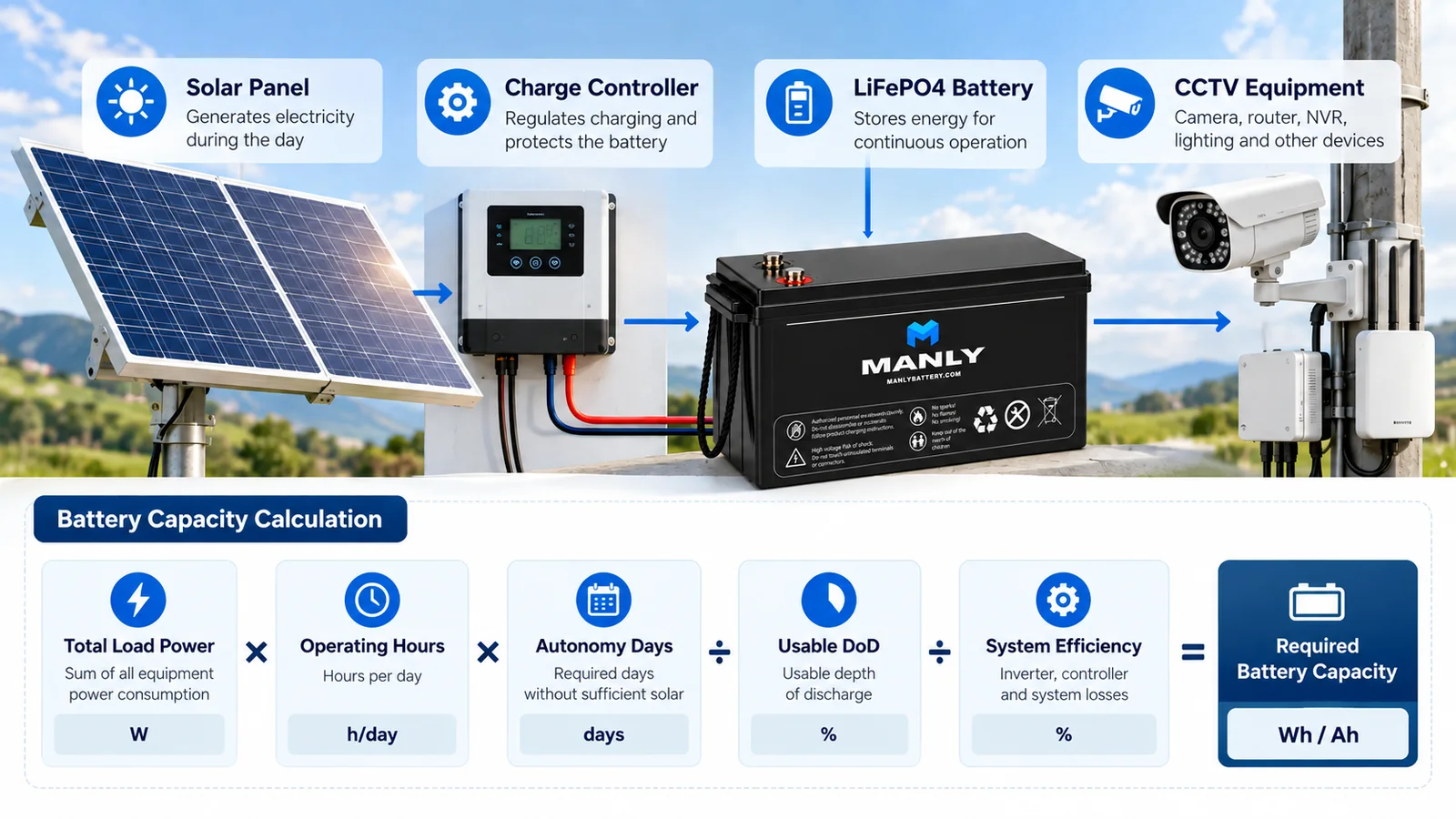
Why Solar CCTV Battery Capacity Cannot Be Selected by Voltage Alone
Two CCTV systems using the same nominal voltage can require very different battery capacities. The total energy demand depends on all equipment connected to the system and how long each device operates.
A complete load review may include cameras, routers or modems, recorders, infrared lighting, sensors, communication equipment and other auxiliary devices. The operating schedule of each load also matters.
For this reason, a “12V CCTV system” does not automatically correspond to a specific Ah capacity. Voltage defines the electrical platform; energy demand determines how much battery capacity is required.
Step 1 — Calculate Daily Energy Consumption
The first step is to calculate the total energy consumed by the equipment each day.
Daily Energy (Wh) = Σ Equipment Power (W) × Operating Hours (h)
For equipment that operates continuously, the daily energy consumption is:
Power (W) × 24 hours
For example, if a surveillance system has a continuous total load of 12W:
12W × 24h = 288Wh/day
Do not calculate only the camera load if the system also includes a router, 4G/5G modem, NVR, lighting, sensors or other devices. These loads should be included in the total daily energy requirement when they are present.
Step 2 — Define the Required Battery Autonomy
Battery autonomy is the period the system should continue operating when useful solar charging is unavailable or insufficient.
Some projects may require approximately one day of battery reserve, while others may require two days, three days or another target. There is no single autonomy value that is correct for every solar CCTV system.
The required autonomy depends on factors such as local weather, seasonal solar conditions, site accessibility, required system uptime and the consequences of an interruption.
If the example system consumes 288Wh per day and the design target is two days of autonomy:
288Wh/day × 2 days = 576Wh
This is the energy that needs to be available to the load before battery design allowances are considered.
Step 3 — Account for Usable Battery Energy
The nominal energy rating of a battery should not automatically be treated as the full amount of energy available to the system. Battery sizing normally includes design assumptions for usable depth of discharge and system efficiency.
A practical calculation can be expressed as:
Required Nominal Battery Energy = Daily Energy × Autonomy Days ÷ (Usable DoD × System Efficiency)
For a calculation example only, assume:
- Usable depth of discharge: 80%
- System efficiency: 90%
Using the previous 576Wh requirement:
576Wh ÷ (0.80 × 0.90) ≈ 800Wh
The 80% depth of discharge and 90% efficiency values above are example design assumptions. They are not universal values for every MANLY battery or every CCTV system. Final assumptions should be confirmed for the actual battery, BMS, controller and operating conditions.
Step 4 — Convert Required Energy from Wh to Ah
After the required battery energy has been estimated, it can be converted into amp-hours using the nominal battery voltage.
Battery Capacity (Ah) = Required Battery Energy (Wh) ÷ Nominal Battery Voltage (V)
For an example 12.8V LiFePO4 battery:
800Wh ÷ 12.8V ≈ 62.5Ah
This means that the simplified calculation produces an estimated requirement of approximately 62.5Ah at 12.8V.
This is a calculation example, not a confirmed battery recommendation.
The final battery configuration must also be checked against the charging system, solar input, controller settings, temperature, battery compartment, load current and other project-specific requirements.
Worked Solar CCTV Battery Calculation Example
| Design item | Example value |
|---|---|
| Continuous system load | 12W |
| Operating time | 24 hours/day |
| Daily energy consumption | 288Wh/day |
| Required autonomy | 2 days |
| Energy before design allowances | 576Wh |
| Example usable DoD | 80% |
| Example system efficiency | 90% |
| Estimated nominal battery energy | ≈800Wh |
| Example nominal battery voltage | 12.8V |
| Calculated capacity | ≈62.5Ah |
The calculation above is intended to demonstrate the sizing process. A real system may use a different voltage, load profile, autonomy target, depth-of-discharge assumption or charging architecture.
Battery Capacity Is Only One Part of the Solar CCTV System
A battery can be correctly sized for the load but still perform poorly if the solar charging system cannot restore the energy used each day.
The battery, solar panel and charge controller should therefore be reviewed as one system.
Important checks include solar panel power, available charging hours, controller charging profile, charge current, battery voltage, seasonal solar conditions and low-temperature charging limits.
A larger battery does not automatically solve a solar energy shortage. If the solar array is too small, the system may operate at a low state of charge for extended periods.
Check Continuous and Peak Current
Energy capacity in Wh or Ah determines how long a battery may support the equipment, but the battery must also support the required current.
Most CCTV loads are relatively steady, but some systems may include communication equipment, lighting, heaters or other devices that create temporary load increases.
The continuous load current and any meaningful peak current should therefore be confirmed before the battery specification is finalized.
Check the Available Battery Space
Two batteries with the same voltage and capacity can have very different physical dimensions.
Battery integration should consider the available compartment dimensions, enclosure style, terminal position, cable routing and mounting requirements.
This is especially important in compact solar CCTV cabinets and mobile surveillance equipment, where installation space may be limited.
MANLY has supplied different mechanical configurations for the same nominal voltage and capacity. The Singapore CCTV battery project, for example, used two different 12.8V 30Ah LiFePO4 battery formats with different housings and connection arrangements.
Check Temperature and Outdoor Operating Conditions
Solar CCTV systems are often installed outdoors, so local temperature conditions should be included in the battery review.
Charging at low temperature requires particular attention for LiFePO4 batteries. Depending on the application, the design may require charging protection, revised controller settings or an optional heated battery configuration.
High-temperature exposure, enclosure ventilation and the installation environment should also be reviewed for the specific project.
Design allowances beyond the simplified calculation
Nominal battery energy (Wh) ≈ nominal voltage (V) × capacity (Ah). This is a nameplate estimate, not a guarantee of energy delivered to the equipment. Review usable depth of discharge, conversion and wiring losses, controller efficiency, temperature, aging and the reserve margin required by the project. Keep each allowance explicit so the same loss is not counted twice.
One, two or three low-sun days are alternative design targets, not standard autonomy promises. A larger reserve also needs a solar charging plan that can recover it while supporting the operating load. Review seasonal solar availability, shading and panel orientation with the controller settings and charge-current limits. Panel rated power alone does not establish daily harvest.
Can LiFePO4 charge below 0°C?
Do not assume that a LiFePO4 pack can accept charge below 0°C. Follow the approved cell and pack charging-temperature limits and the BMS charge-enable conditions. A heated configuration needs its own confirmed control sequence and energy allowance; a low-temperature discharge rating does not establish permission to charge at that temperature.
What Information Should You Send to a Battery Supplier?
A useful solar CCTV battery review normally starts with the equipment rather than a battery model number.
- System voltage
- Total continuous power consumption
- Operating schedule
- Required runtime or autonomy
- Solar panel specifications
- Charge controller brand, model and settings
- Maximum battery dimensions
- Minimum and maximum operating temperature
- Continuous and peak current where applicable
- Estimated project quantity
If an existing battery is already used in the equipment, its specification, dimensions, wiring and photos can also help define a replacement or upgraded LiFePO4 configuration.
For a broader checklist covering electrical and mechanical requirements, see our custom LiFePO4 battery specification guide.
From Calculation to Battery Configuration
For wider outdoor equipment integration, see Solar & Remote Equipment. For a project-specific enclosure or electrical interface, review Custom Battery Engineering.
The calculation provides a starting point, but the final battery should be reviewed together with the actual CCTV equipment, solar charging system and installation constraints.
MANLY develops LiFePO4 battery configurations for solar CCTV and mobile surveillance systems, including projects that require custom capacity, enclosure dimensions, wiring and electrical integration.
Our published Singapore CCTV battery project documents two delivered 12.8V 30Ah battery configurations. The project record confirms the battery specifications and mechanical formats; camera load, solar panel size and actual system autonomy are not documented and are not inferred.
SOLAR CCTV BATTERY PROJECT
Need a Battery Configuration for Your Surveillance System?
Send us your system voltage, equipment load, solar panel, controller, required autonomy and available battery space. We can review the battery architecture against the actual equipment requirements.